
About the Journal
Journal of Nano Materials Impact (NanoMatImp) is a leading science and technology journal that publishes rigorous and robust research papers relevant to nanoscience and nanotechnology to an interdisciplinary and diverse audience of scientists and researchers.
NanoMatImp is published quarterly by Mustansiriyah University. It is subject to an open-access policy and follows a rigorous, double-blind peer review process. NanoMatImp is a medium for global academics to publish experimental contributions, exchange knowledge, and disseminate the latest discoveries and developments in nanomaterials science and nanostructured materials.
The range of disciplines accepted for publication in NanoMatImp is diverse, with paper types such as Full Papers (original research), Review Articles, and Scientific Reports. The range of disciplines accepted for publication at NanoMatImp is in Applied Science, including relevant to academic natural sciences (physics, chemistry, biology, medicine, pharmacy, agriculture, biomedical sciences, and environmental sciences) as well as manufacturing and engineering of advanced materials, energy, photonics, and electronics devices.
It is NanoMatImp's policy and goal to publish high-quality research. Therefore, the dedicated Editorial Board and specialist reviewers will subject all submitted manuscripts to a rigorous review process, starting with carefully checking for plagiarism using professional software (Turnitin) and a double-blind peer review process. Authors are not obligated to pay any fees for submission and peer review processing of the submitted manuscript.
Once the articles have been accepted, authors will receive an acceptance letter. These articles will then be freely available to the public in a permanent electronic copy in PDF format for unrestricted reading and downloading.
Sincerely,
Editor in Chief (NanoMatImp)
Current Issue
Volume 2 Issue 1 (2026)
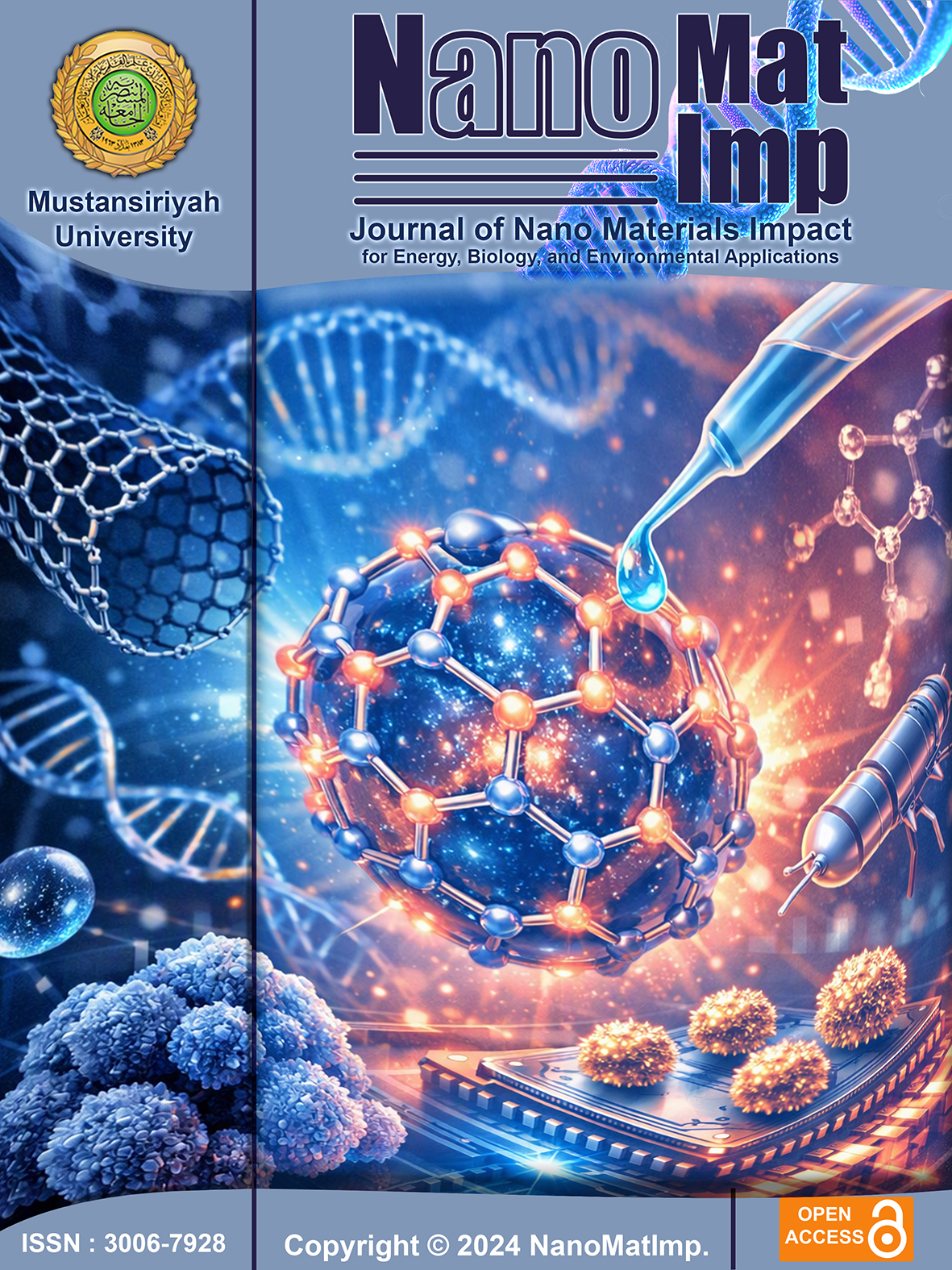
This inaugural issue of Volume 2 presents a diverse collection of cutting-edge research exploring the multifaceted applications of nanomaterials across biomedical, agricultural, and material science domains, comprising five original articles that collectively demonstrate the transformative potential of nanotechnology in addressing contemporary scientific challenges. The first paper investigates nano-encapsulated cinnamon and coriander extracts as feed additives for quail production, highlighting how encapsulation technology can enhance bioavailability and gut absorption of phytogenic compounds, while the second contribution explores the therapeutic potential of cerium oxide nanoparticles synthesized via PVP-assisted co-precipitation for modulating biochemical markers in acute kidney injury, demonstrating significant antioxidant and renal-protective effects through the Ce3+/Ce4+ redox cycle mechanism. The third article presents a reproducible methodology for evaluating nanoparticle-mediated radiotherapy enhancement, providing a standardized framework for quantifying both dose enhancement factors and sensitizer enhancement ratios under clinical photon-beam conditions, whereas the fourth contribution employs density functional theory calculations to investigate nitrogen-doped aluminum phosphide nanosheets, revealing tunable electronic and optical properties suitable for advanced optoelectronic applications. The final paper examines surface modification of Ti6Al4V alloys using dielectric barrier discharge plasma, demonstrating enhanced bioactivity through improved hydrophilicity, corrosion resistance, and bone-like apatite formation. Collectively, these studies showcase the interdisciplinary nature of nanotechnology research, spanning animal nutrition, nanomedicine, cancer therapy, computational materials science, and biomedical engineering, and underscore the journal's commitment to advancing fundamental understanding and practical applications of nanomaterials across diverse scientific fields.
Published:
15.02.2026